Being under the weather for most of last week has taken its toll with the extra workload this week. I've been busy catching up on parochial duties, etc. and today, Remembrance Day, promises not to be any different: Morning Prayer, Requiem, Bible Study, a Confession, work on a new Mass booklet, Mass and Vestry to round off the day! Busy. So, my apologies for the lack of posts. I do have pictures from the parish's All Souls Requiem as well as the final two installments of my holidays snaps (please, no more, I hear you say!), and some thoughts and reflections on the newly-released Apostolic Constitution, Anglicanorum Coetibus. So, more later!
Wednesday, 11 November 2009
Saturday, 7 November 2009
Conwy and Bodnant
S. Mary & All Saints Parish Church (12th, 14th, 15th & 16th Centuries)built on the foundation of the 12th Century Cistercian Aberconwy Abbey
with tomb marked "We Are Seven", containing seven brothers and sisters
used as a residence from the 16th Century to 1900
A few snaps of our brief morning in Conwy (we always called it Conway when I was a wee lad), known for its imposing 13th Century castle and almost completely intact and unbroken walls (with twenty-one towers) which surround the town. These structures were built by order of English King Edward I to advance his conquest of the principality and so repel invading Welsh armies. I spent many happy memories in Conwy and neghbouring towns as a child, since North Wales was one of my parents' favourite holiday destinations - and with good reason. It's a very fine town, though the standard of shops has declined in recent years and there are now just too many souvenir shops. How many fluffy Welsh dragons and 'Castles of Wales' guidebooks does one need!?
Thankfully, it was quiet in Conwy and it felt as though we had the walls to ourselves. It was very peaceful indeed. Sadly, the Smallest House in Great Britain (for the record, where is the smallest in Northern Ireland?) was closed, as was Plas Mawr, so we were a little disappointed that these two gems were closed. The fine Aberconwy House, the only surviving medieval merchant's house in Conwy, is now owned by the National Trust, and is their shop, and we didn't really fancy looking at yet more souvenirs. So, we moved on and walked some more. Conwy is a nice place to walk around.
We did, however, manage to gain access to the parish church. We were looking forward to being there, not least because it was listed in the Forward in Faith directory as the only FiF-friendly parish in the Diocese of Bangor. We thought that there might even have been a Midday Mass. The parish priest, residing in his modern vicarage next door - in the shadow of its much-grander Edwardian forebear - was obliging enough, but seemed mildly confused at the request to look inside his church; even more so when I told him I was a priest. (Ah, perhaps he was right, and I am mad to ask to look inside churches during my hols!) Still, he handed over the keys. Upon entering the dark and somewhat dank church, however, I began to see what he might have meant by his reluctant welcome. The exterior seemed promising enough, but the interior was frightfully depressing and cold and lacked any visual signs of Catholic influence, save for a crucifix above the pulpit. The church did have some nice ancient features, but the holy water stoup was empty and I couldn't find the reserved Sacrament anywhere. Given the venerable history of a parish such as this, together with its prime location in the very centre of a walled medieval town, it seems utterly remarkable that it isn't open to the public during the day, at least for private prayer. I think there could be immense potential for a parish such as this in a town such as Conwy. Sadly, I left the church wondering what merited its includsion in the FiF directory. . .
A short drive later and we were in the 80-acre Bodnant Garden, close to Tal-y-Cafn, a place we had earmarked for a visit after watching the BBC's recent Bodnant: A Garden in Snowdonia. The estate is undergoing a £2 million improvement. It is certainly beginning to show signs of that improvement and we were suitably impressed with our visit. The Garden has been in the hands of the National Trust since 1949, but the House, originally built in 1792 but remodelled in the late 19th Century, together with the Bodnant Estate, are still in the hands of the Aberconway family, who reside there to this day.
Lunch was taken in the Tea Rooms at Bodnant, and I think the pictures tell the rest of the story perfectly!
And some news just in. Many congratulations to fellow-blogger, Fr. Ed Tomlinson and to his wife, Hayley, on the birth of their son, Benedict Peter, who I am sure will be a wonderful little brother to sister Jemima. Wonderful news! Wonderful name!
Thankfully, it was quiet in Conwy and it felt as though we had the walls to ourselves. It was very peaceful indeed. Sadly, the Smallest House in Great Britain (for the record, where is the smallest in Northern Ireland?) was closed, as was Plas Mawr, so we were a little disappointed that these two gems were closed. The fine Aberconwy House, the only surviving medieval merchant's house in Conwy, is now owned by the National Trust, and is their shop, and we didn't really fancy looking at yet more souvenirs. So, we moved on and walked some more. Conwy is a nice place to walk around.
We did, however, manage to gain access to the parish church. We were looking forward to being there, not least because it was listed in the Forward in Faith directory as the only FiF-friendly parish in the Diocese of Bangor. We thought that there might even have been a Midday Mass. The parish priest, residing in his modern vicarage next door - in the shadow of its much-grander Edwardian forebear - was obliging enough, but seemed mildly confused at the request to look inside his church; even more so when I told him I was a priest. (Ah, perhaps he was right, and I am mad to ask to look inside churches during my hols!) Still, he handed over the keys. Upon entering the dark and somewhat dank church, however, I began to see what he might have meant by his reluctant welcome. The exterior seemed promising enough, but the interior was frightfully depressing and cold and lacked any visual signs of Catholic influence, save for a crucifix above the pulpit. The church did have some nice ancient features, but the holy water stoup was empty and I couldn't find the reserved Sacrament anywhere. Given the venerable history of a parish such as this, together with its prime location in the very centre of a walled medieval town, it seems utterly remarkable that it isn't open to the public during the day, at least for private prayer. I think there could be immense potential for a parish such as this in a town such as Conwy. Sadly, I left the church wondering what merited its includsion in the FiF directory. . .
A short drive later and we were in the 80-acre Bodnant Garden, close to Tal-y-Cafn, a place we had earmarked for a visit after watching the BBC's recent Bodnant: A Garden in Snowdonia. The estate is undergoing a £2 million improvement. It is certainly beginning to show signs of that improvement and we were suitably impressed with our visit. The Garden has been in the hands of the National Trust since 1949, but the House, originally built in 1792 but remodelled in the late 19th Century, together with the Bodnant Estate, are still in the hands of the Aberconway family, who reside there to this day.
Lunch was taken in the Tea Rooms at Bodnant, and I think the pictures tell the rest of the story perfectly!
And some news just in. Many congratulations to fellow-blogger, Fr. Ed Tomlinson and to his wife, Hayley, on the birth of their son, Benedict Peter, who I am sure will be a wonderful little brother to sister Jemima. Wonderful news! Wonderful name!
Posted by
Fr Lee Kenyon SSC
at
04:34
Friday, 6 November 2009
Remember, remember
For the first time in living memory, last night was peaceful and the air was as clear and as fresh as it has been for the preceding nights. No fireworks. No smell of smoke. No Protestant-based commemoration of Guy Fawkes' 1605 Gunpowder Plot to blow up the Houses of Parliament in an effort to reconcile - albeit in a roundabout way - England with the Holy See. Although Bonfire Night is still, in a limited way, kept in parts of the provinces of British Columbia and Newfoundland & Labrador (the latter being a British colony until 1947), it is left largely unobserved in Canada.
Whilst Harvest Festival, Battle of Britain Sunday, Remembrance Sunday, the Queen's official birthday, Mothering Sunday, Boxing Day, and other (British-influenced) cultural and religious observances are maintained here in Canada, Guy Fawkes Night is not really kept. A quick look at Wikipedia - reliable and trustworthy source that it is(!) - reveals that Guy Fawkes Night has all but disappeared in Britain's former colonies, with restrictions on the purchase and useage of fireworks having put paid to traditional 'celebrations.' In Colonial America, George Washington banned any commemoration of it amongst his troops, though up until the 1730s it was popular in Boston, with street parades which "mocked Catholicisim and the Catholic Stuart Pretender".
Notwithstanding objections to the origins of Guy Fawkes Night, I do miss the revelry and community spirit of standing around a bonfire, eating a toffee apple and waving a sparkler. . . Fr. Michael Gollop, in a post today, found here, offers a salutary reminder of the danger of neglecting one's cultural and religious past :
Whilst Harvest Festival, Battle of Britain Sunday, Remembrance Sunday, the Queen's official birthday, Mothering Sunday, Boxing Day, and other (British-influenced) cultural and religious observances are maintained here in Canada, Guy Fawkes Night is not really kept. A quick look at Wikipedia - reliable and trustworthy source that it is(!) - reveals that Guy Fawkes Night has all but disappeared in Britain's former colonies, with restrictions on the purchase and useage of fireworks having put paid to traditional 'celebrations.' In Colonial America, George Washington banned any commemoration of it amongst his troops, though up until the 1730s it was popular in Boston, with street parades which "mocked Catholicisim and the Catholic Stuart Pretender".
Notwithstanding objections to the origins of Guy Fawkes Night, I do miss the revelry and community spirit of standing around a bonfire, eating a toffee apple and waving a sparkler. . . Fr. Michael Gollop, in a post today, found here, offers a salutary reminder of the danger of neglecting one's cultural and religious past :
I did go through a period of thinking one shouldn’t celebrate 5th November because of its historical connotations, but now think that was just a strangely aberrant form of PC-ism too: we can’t alter our country’s often tragic religious history, or in any meaningful way apologise for the events of the distant past, but perhaps we do now have an opportunity to change its trajectory – what can I be thinking of now!So, perhaps next year, we shall resurrect Guy Fawkes Night, or at least Bonfire Night, in the Province of Alberta (whose British roots are impeccable, for it was named for Princess Louise Caroline Alberta, fourth daughter of Queen Victoria and husband of the Marquess of Lorne, Governor-General of Canada, and the province currently has 200,000 expatriate British), if only for the sake of the toffee apples.
Posted by
Fr Lee Kenyon SSC
at
17:34
Thursday, 5 November 2009
St Asaph
Our post-Chester travels took us to the small town of St. Asaph in historic Flintshire (modernists would have you believe it was in Denbighshire!), and to its 13th Century Cathedral Church, built on site of the monastic foundation established by S. Kentigern ca.560. The medieval cathedral is only less charming than its diocesan bishop, the Rt. Revd. Dr. Gregory Cameron who, as cited in Ruth Gledhill's Times blog, recently accused Pope Benedict XVI of "ecumenical bad manners" in promulgating the Apostolic Constitution for former Anglicans wishing to enter into full communion with the Holy See. You can read his views here.
Episcopal silliness aside, the cathedral was, in my view, a mixed bag. It was small and intimate - reputed, like its neighbour St. David's, to be the smallest cathedral in Wales - and it is very old. It sits in a community which is very proud of its past city status and the local authority refers to itself as the 'City of St. Asaph Town Council'. Quaint! The Choir and High Altar were stunning. Warm, Victorian, and lush, but I take serious issue with the glass nave altar and the rotting Christus - he didn't rot on the Cross! There were some nice nooks and crannies, but it did feel rather bare and somewhat secular in parts - the chairs certainly didn't help - though this might be because it's so small and thus difficult to adequately provide for a secluded bookshop, etc. The setting, however, was idyllic. We walked down the high street to the parish church, dedicated to SS. Asaph & Kentigern, and listed in the Domesday Book, but, alas, it was closed.
I am still in a period of confinement, as it were, with many sniffles and a bad head cold. I haven't ventured out since All Souls' Day, so this is all I can offer at present. Blessings!
Episcopal silliness aside, the cathedral was, in my view, a mixed bag. It was small and intimate - reputed, like its neighbour St. David's, to be the smallest cathedral in Wales - and it is very old. It sits in a community which is very proud of its past city status and the local authority refers to itself as the 'City of St. Asaph Town Council'. Quaint! The Choir and High Altar were stunning. Warm, Victorian, and lush, but I take serious issue with the glass nave altar and the rotting Christus - he didn't rot on the Cross! There were some nice nooks and crannies, but it did feel rather bare and somewhat secular in parts - the chairs certainly didn't help - though this might be because it's so small and thus difficult to adequately provide for a secluded bookshop, etc. The setting, however, was idyllic. We walked down the high street to the parish church, dedicated to SS. Asaph & Kentigern, and listed in the Domesday Book, but, alas, it was closed.
I am still in a period of confinement, as it were, with many sniffles and a bad head cold. I haven't ventured out since All Souls' Day, so this is all I can offer at present. Blessings!
Posted by
Fr Lee Kenyon SSC
at
15:45
Wednesday, 4 November 2009
Chester
Our recent trip to England took in Chester and its Cathedral Church of Christ and the Blessed Virgin Mary, which became the cathedral church of the new Diocese of Chester in 1541. Prior to the Reformation, the Cathedral was S. Werburgh's Abbey, a Benedictine foundation which dated from 1093. It's a very beautiful cathedral and its sandstone walls give a very warm pinkish glow to all things. The High Altar is well-appointed, but seldom used for the principal Mass on Sundays. Like other cathedrals a westward-facing nave altar has been erected beyond the Quire, though I noted that the High Altar was still used for the early Mass on Sundays, as well as for Mattins and Evensong.
We attended Choral Evensong on a Sunday evening and encountered an initial shock. After the bell rang, the Choir entered andthey were all in green hospital gowns (well, it's the closest thing I can think to say they looked like). Thankfully, we were reassured that these singers were visitors and that the real Choir were in Bruges. Just as well, because I was ready to snap at what I thought was a retro-60s look, similar to the nonsensical liturgical garb adopted by the powers that be at places like Coventry Cathedral.
We are all under the weather here, so I shall sign off for now. Before I do, please take time to sign this petition organised by C-FAM (the Catholic Family & Human Rights Institute), based in the United States, which is seeking to present 1,000,000 signatures to the United Nations in December asking member states to begin interpreting the Universal Declaration of Human Rights as protecting the unborn child from abortion. Thank you.
P.S. Teething trouble on the Comments. . . back soon.
We attended Choral Evensong on a Sunday evening and encountered an initial shock. After the bell rang, the Choir entered andthey were all in green hospital gowns (well, it's the closest thing I can think to say they looked like). Thankfully, we were reassured that these singers were visitors and that the real Choir were in Bruges. Just as well, because I was ready to snap at what I thought was a retro-60s look, similar to the nonsensical liturgical garb adopted by the powers that be at places like Coventry Cathedral.
We are all under the weather here, so I shall sign off for now. Before I do, please take time to sign this petition organised by C-FAM (the Catholic Family & Human Rights Institute), based in the United States, which is seeking to present 1,000,000 signatures to the United Nations in December asking member states to begin interpreting the Universal Declaration of Human Rights as protecting the unborn child from abortion. Thank you.
P.S. Teething trouble on the Comments. . . back soon.
Posted by
Fr Lee Kenyon SSC
at
13:13
Tuesday, 3 November 2009
Success?
I don't know if this will work, but I've being trying to get Comments on the blog now for what feels like and eternity. It's not perfect, but I think I've managed to do something that will allow people to leave comments. Let me know if it works . . . or doesn't! Just click 'Comments' below and you should be able to leave a comment.
What a pain.
Posted by
Fr Lee Kenyon SSC
at
15:34
Monday, 2 November 2009
An Anglo-Canadian Perspective
Holy smoke at Solemn Mass, S. John's, Calgary
Evensong and Benediction last night for All Saints Day brought in just over twenty of the faithful, and we were treated to a very good expository sermon on S. John Chapter 6 by our friend the Revd. Jonathan Gibson, Rector of S. Augustine's, Calgary, a local evangelical Anglican parish here in the city. It was Jonathan's first exposure to Benediction and I think it left him with more questions than answers, but I salute his willingness to participate and share our Catholic way of living and worshipping. Since S. John's suffers a certain degree of isolation - the nearest orthodox Anglo-Catholic parish being over a thousand miles away - it is a blessing that we have excellent relations with our evangelical brethren, many of whom were happy to say Mass during the recent interregnum, evening donning birettas and sporting maniples as they went unto the altar of God. Thank you, Reverend Sirs.
Which, in a roundabout way, leads me to some consideration of what the forthcoming Apostolic Constitution might mean for a parish such as my own. I made an announcement yesterday from the pulpit which stated that whilst I welcomed the announcement of an accommodation for Anglicans - patrimony, lay folk, married priests, etc., however you may wish to define it - and said that I was indeed excited by the possible options open to Anglicans, I made it clear that now was not the time for decisions, for there were no options to decide upon. I said that the media had, predictably, got their information wrong and that when they did have their facts, they didn't necessarily always have them in the right order.
One voice which I do not think has been heard properly is that of the isolated Anglo-Catholic parish, particularly in such a far-flung place as my own parish. Much news has covered England and the United States, but not Canada. But it isn't as if Anglo-Catholicism doesn't exist here. I know many of the historic parishes have become liberal (S. Mary Magdalene's, Toronto, S. James, Vancouver, etc.) and that many Anglo-Catholic priests and laity left the Anglican Church of Canada to join the continuing Anglican Catholic Church of Canada over Prayer Book revision and the ordination of women, but, with those significant exceptions aside, orthodox Anglo-Catholicism does still exist, and indeed flourishes in many places, not least in my own parish. S. Thomas, Huron Street, Toronto still bears witness to Catholic faith and practice (with its Wards of the Society of Mary and C.B.S.), so too at S. John the Evangelist, Montreal (with its S.S.C. rector and its 141 year-old Ward of the C.B.S.), and also at SS. Michael & All Angels, Winnipeg, S. Barnabas, Ottawa, Forward in Faith parishes of S. John the Divine, Courtenay, B.C., and S. Mary's, Frederickton, New Brunswick. It is, sadly, not a very extensive list, but visits to the websites of these parishes (where available) will reveal very vibrant and robust Anglo-Catholic life and witness in many of these historic (by Canadian terms) churches.
Once it's been accepted, then, that there are, still, in places like Canada, parishes, lay folk and priests who care deeply about the faith once delivered to the saints and even - 33 years on - remain conscientiously opposed the ordination of women to the ministerial priesthood, the next question must surely be what is the present reality in these places, and what does the future hold for them? Remember, in Canada there are no bishops and dioceses like Fort Worth, Quincy and San Joaquin, nor even Blackburn or Chichester (where two integrities sort-of work well). My own diocese began ordaining women to the priesthood somewhat later than most other Canadian dioceses, in 1989, but it remains the case that there are no 'safe havens' for traditionalists. There is no conscience clause - it was rescinded in 1986 - and there are no PEVs, not even a code of practice, and women bishops have been part of the Anglican scene here since 1993. Furthermore, in the Diocese of Calgary, I am one of two priests of the Society of the Holy Cross. There is one C.B.S. Ward, one Guild of All Souls branch, one Walsingham Cell - all in my parish. There are no 'sound' Chapters, no Forward in Faith Festivals, no Provincial Festivals. . . And, yet, here we are. Still proclaiming the faith in much the same way as English, Welsh, Australian and American orthodox Anglo-Catholic parishes have always done.
How isolated parishes like this survive is a credit to the Holy Ghost! And I don't mean to be flippant with that remark. Other than my good evangelical brethren coming to support our work and ministry here at S. John's, I have no other priestly fraternity, let alone any Catholic fraternity. And yet God, in his infinite goodness and mercy, has called me to this place and to minister to these people, against the odds and at a time in the life of the Church when there seems to be little place, if any, for orthodox traditionalist Anglicans. That S. John's, Calgary is called to be S. John's, Calgary is not in doubt, but in the absence of true Catholic leadership in Canada, to whom do orthodox Anglo-Catholic parishes in this country turn for advice or counsel?
After decades of the faithful in my own parish feeling - and knowing - that there is no honoured place for them or their theological positions in the Church of their baptism (and for many of them it was the Church of England in Canada when they were baptised) - what else does the removal of a conscience clause mean? - at last comes news from the Holy Father that these people, and their views, and their patrimony could, finally, have a home and that honoured place for which they long.
I, certainly, don't have all, if any, of the answers, but what I do have an almost unique perspective on what an honoured place for an Anglo-Catholic parish - sans existing conscientious protection - which seeks to further its Catholic life, faith, witness and outreach might mean. For one, there would, certainly, be a immense degree of freedom. Freedom to be who they are and freedom to practice their faith in a way which is fully in accordance with the Catholic life which they currently strive to live. Would going over to Rome really mean that these people, or I, would forsake past Anglican ministry? I don't see how it would, given that accommodation for our deep Anglican patrimony and heritage would be preserved. Furthermore, conversion and unity are positive, not a negative, steps, and surely doing the Lord's will for the sake of the unity of the Church worldwide is no bad thing? When a church such as mine has suffered so much isolation and has felt cast down and on the margins of a national Church of which many parishioners hold has departed the historic faith once delivered to the saints, embracing the fullness of Catholic Christian faith would be no bad thing at all. Of course, the devil is in the detail and we must wait until the Constitution is published. But, in the meantime, it's certainly worth bearing in mind that this isn't just about England or the United States, nor any old-fashioned attachment to the Church of England because, from where I'm sitting, the dear old C. of E. - the Church of my own baptism, upbringing, confirmation and ordination - risks going in much the same direction as the Anglican Church of Canada, new - and very welcome - episcopal appointments to suffragan sees aside!
Oh dear, I feel that this is all a bit heavy, so I shall probably post over this later with some photographs of Chester from last week. In the meantime I must get on. I have an article for The Church Observer to finish, a Solemn Requiem to prepare for - the catafalque still needs to be erected, and a dear little 5 year-old boy who is suffering from croup to look after.
Posted by
Fr Lee Kenyon SSC
at
18:32
Sunday, 1 November 2009
Preston Wanderings
Sadly, I have no pictures from today's Procession and Solemn Mass for All Saints. Happy Solemnity! It was good to be back in the parish and at home at the altar again, even if the voice had to do a little overtime with the required chanting and loud speaking (we don't use any radio mikes at S. John's - I told you we were trad!) Numbers were up, which was a delight, and the Choir had grown by three in my absence - perhaps I should go away more often? C.B.S. Solemn Evensong and Benediction are tonight, with four admissions to our new Ward of the Confraternity planned, and we welcome a local evangelical-minded priest who will be preaching on the meaning of the Eucharist for him. Refreshments will follow at the Rectory, so all should be enjoyable.


Elevation of the Host
Last Sunday I was in Preston with Fr. Andrew Teather. The pictures above show two Low Masses offered on Saturday and Sunday last, one for S. Raphael, Archangel and one for Christ the King which, in the pre-1962 Kalendar, falls on the last Sunday of October. Fr. Andrew's chapel at the top of his house is wonderfully peaceful and will offer a much-needed refuge and place of rest and silence at the end of his long and busy days ministering in a very hectic parish. I'm thankful to him for his gracious hospitality and enduring friendship which, despite the distance of 5,000 miles, is something for which I am immensely grateful.
Following my own Mass on the Sunday morning, it was time to head off to the exquisite Georgian church of S. George the Martyr, where Fr. Andrew serves as Curate, for a joint Mass for the two churches in the Parish of Preston, the other being the Minster Church of S. John. My apologies for the blurry nature of many of the photographs; it's hard to be good and inconspicuous when taking snaps of liturgical proceedings. Anyway, enjoy all the same. I certainly did. The Parish of Preston is a vital witness to this Lancashire community, where the beauty and truth of the Catholic Faith as received by the Church of England is celebrated to the full.
I am now off to have a cup of Yorkshire Tea, before going off to scrub the living room floor, set up in church, sing Evensong, give Benediction, have a jolly nice reception and then probably collapse before the busyness of tomorrow's three Requiems for All Souls. In the meantime, I leave you with these photographs, taken in no particular order, of beautiful S. George's, Preston.
Following my own Mass on the Sunday morning, it was time to head off to the exquisite Georgian church of S. George the Martyr, where Fr. Andrew serves as Curate, for a joint Mass for the two churches in the Parish of Preston, the other being the Minster Church of S. John. My apologies for the blurry nature of many of the photographs; it's hard to be good and inconspicuous when taking snaps of liturgical proceedings. Anyway, enjoy all the same. I certainly did. The Parish of Preston is a vital witness to this Lancashire community, where the beauty and truth of the Catholic Faith as received by the Church of England is celebrated to the full.
I am now off to have a cup of Yorkshire Tea, before going off to scrub the living room floor, set up in church, sing Evensong, give Benediction, have a jolly nice reception and then probably collapse before the busyness of tomorrow's three Requiems for All Souls. In the meantime, I leave you with these photographs, taken in no particular order, of beautiful S. George's, Preston.
Posted by
Fr Lee Kenyon SSC
at
21:19
Saturday, 31 October 2009
All Hallows Eve
Elevation of the Host
Ecce, Agnus Dei
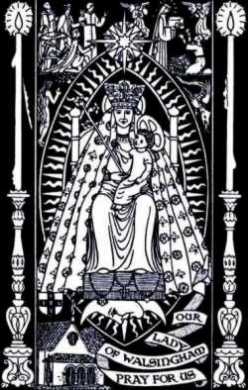
Admission to the Society of Our Lady of Walsingham
A few shots of this morning's Low Mass for the Vigil of All Saints. I was, rarely, without a server at Mass, and no so lifting of the chasuble at the elevations (should the curious wonder. . .) I was pleased to admit my mother-in-law and fellow Wanderer, the renowned author Donna Fletcher Crow, to the Society of Our Lady of Walsingham, and thus to our Walsingham Cell at S. John's. American Mum, as I call her, 'held the fort' during our recent holiday and did a sterling job of looking after two of the most beautiful little handfuls in the world. Bravo.
And, just to show that I'm not really all that miserly when it comes to the secular 'celebrations' of today, I include a picture of Dominic in his Batman costume (sans headgear), worn for his Hallowe'en party at school yesterday. As a Roman Catholic school, they insisted that costumes were to be solely favourite comic/cartoon/fairy tale characters. Nothing ghoulish was permitted. Quite right. I let slip on the Jack o'lantern, though. . . ;-)
Posted by
Fr Lee Kenyon SSC
at
17:00
The Wanderer Returns
home to the B.B.C.'s Daily Service
My apologies for the lengthy absence from the blog. I was, as you know, in England and Wales for much of last week. By the time we reached Portmeirion on Monday, back pain and an oncoming flu were beginning to make themselves nicely settled in my company. But, of course, I was on holiday, so that was bound to happen. . . I was also somewhat foolish in failing to take the required thingamabob needed to allow my camera's memory card (it being of an antiquated type) to speak to my computer. And I couldn't post without pictures, could I? I am now lying low for a couple of days, heavily fortified with oil of oregano and appropriate pills, before the busyness of All Saints and All Souls take over. The greatest challenge, of course, will be trying to convince my parishioners that I do not have swine flu. . .
Inconvenient sickness aside, I am pleased to say that a good and relaxing time was had by all. It was a wonderful opportunity for us to spend time in some truly delightful places - some known, others unknown - and for us to get to value just a few of the gems to be found in the Sceptred Isle. If I learned anything from our trip, it was this: you don't know what you got till it's gone (apologies to 1980s' Glam metal band Cinderella). So, we enjoyed spending time with my parents in Manchester - obligatory pictures of the suburb of Didsbury given above - and occupying ourselves with one of our favourite pastimes: looking for bargains in charity shops.
12th Century foundation, with 14th, 15th, 16th and 19th Century additions!
and ghastly on account of its cartoon-esque reredos saints
We continued the theme when we visited Fr. Andrew in Preston over the weekend and took a day out to Skipton in Yorkshire and Clitheroe in Lancashire, with a hearty pub lunch at the Tempest Arms in Elslack in-between the two. It was a real joy for Elizabeth and I be able to walk about and shop without any child commitments nor time constraints and to visit a church without having to worry about having to do anything in it! That said, two Low Masses according to the English Missal were offered in Fr. Andrew's well-appointed domestic oratory (I'm waiting to receive photographs to share) which sits at the top of his stunning Georgian home in Preston. I told him that his house was larger and grander than most parish priests' homes, and he agreed. Hm.
I know that this has been a very holiday-orientated post and lacks the necessary theological robustness required of Anglo-Catholic blogs(!), but I was on holiday and this is, after all, only a blog! I do have some thoughts on matters ecclesiological and ecclesiastical, even news of a conversation with a Mirfield Father about the forthcoming Apostolic Constitution, no less, but they'll have to wait until I am back to full speed. . . In the meantime, Happy All Hallows' Eve. None of this secular North American Hallowe'en nonsense for me!
Posted by
Fr Lee Kenyon SSC
at
11:35
Subscribe to:
Comment Feed (RSS)